
How to Set Goals for 2026 That Actually Work | Evidence-Based Guide
Most goal-setting advice fails because it ignores biology — specifically how the menstrual cycle affects motivation, thinking style, and follow-through across a 28-day rhythm. This guide lays out an evidence-based goal-setting framework for women, explaining why the luteal phase (days 15–28) is the optimal window for honest, strategic planning, how the WOOP method outperforms positive visualisation by accounting for real barriers, and why written goals are achieved 42% more often than mental ones — particularly when cycle syncing is used to time execution to your biology.
Introduction
You know the drill. New year, new goals, new journal that may well be abandoned by February.
But why does that happen? Well, most goal-setting advice ignores two critical factors - your biology and basic behavioral science. You set goals when you're buzzing with optimism (hello, ovulation or New Year's energy), then wonder why you can't sustain that same enthusiasm three weeks later when progesterone drops and life gets real.
This guide is written to fix all that. You're going to set goals during the right biological window, structure them so your brain actually wants to pursue them, and build a monitoring system that works with your cycle, not against it.
By the end, you'll have a goal-setting framework you can actually follow. Not because you're more disciplined than before, but because you're finally working with how your brain and body actually function. Sounds great right? So let’s get stuck in.
Download our 2026 goal setting checklist
Part 1: Pick Your Goal-Setting Window (Timing Matters More Than You Think)
Why Your Luteal Phase Is Your Secret Weapon
Most people set goals when they feel inspired - mid-cycle, high estrogen, everything feels possible. But the problem is that that’s not your baseline. That's your peak.
Your luteal phase (roughly days 15-28 of your cycle, the two weeks before your period) is when progesterone rises and estrogen drops. You're naturally more:
- Realistic about what you can handle
- Attuned to what's actually draining you
- Clear on what needs to change
- Less likely to overcommit to things that sound good but feel unsustainable
Goals set during luteal phase are grounded in reality, not fueled by temporary neurochemical optimism, so use it to your advantage.
Action Step:
Check your cycle tracker. Block 2-3 hours during your luteal phase—ideally mid-luteal (days 18-23) when you're reflective but not yet in pre-menstrual low energy.
Set Up Your Environment
You're doing strategic life planning, not answering emails.
Non-negotiables:
- Phone on Do Not Disturb
- 90+ minutes of uninterrupted time
- Somewhere comfortable (not your usual work desk if possible)
- Water, tea, whatever makes you feel settled
- Notebook or digital doc—whichever you'll actually use later
This isn't aesthetics. Your environment signals to your brain whether this matters. Make it matter.
Part 2: The Life Audit (Where You Are vs. Where You Want to Be)
Map Your Current Reality Across 5 Core Areas
Don't skip this. You can't set useful goals if you don't know what actually needs fixing.
Rate yourself 1-10 (honestly) in these areas:
1. Career/Work – Fulfillment, growth, compensation, workload
2. Health/Energy – Physical health, sleep, energy levels, cycle symptoms
3. Relationships – Quality of connections, boundaries, time with people who matter
4. Financial – Stability, stress levels, progress toward security
5. Personal/Growth – Learning, creativity, hobbies, sense of purpose
For each area, answer:
- Where am I now? (1-10 rating + one sentence reality check)
- Where do I want to be by end of 2026? (1-10 target + specific vision)
- What's the ONE thing that would make the biggest difference here?
Pick Your 4-5 Focus Areas
Here's the hard part: You can't fix everything at once. Look at your audit and decide, which 4-5 areas genuinely need attention this year? Not "would be nice" - genuinely need. Cross off the rest - write "2027" next to them and move on
Why this works: Your brain has finite processing power. Research on goal pursuit shows people who focus on 2-4 goals have significantly higher completion rates than those juggling 7+. You're not being lazy. You're being strategic.
Part 3: Structure Your Goals (Make Them Achievable, Not Aspirational)
The SMART Framework (It's Overused Because It Works)
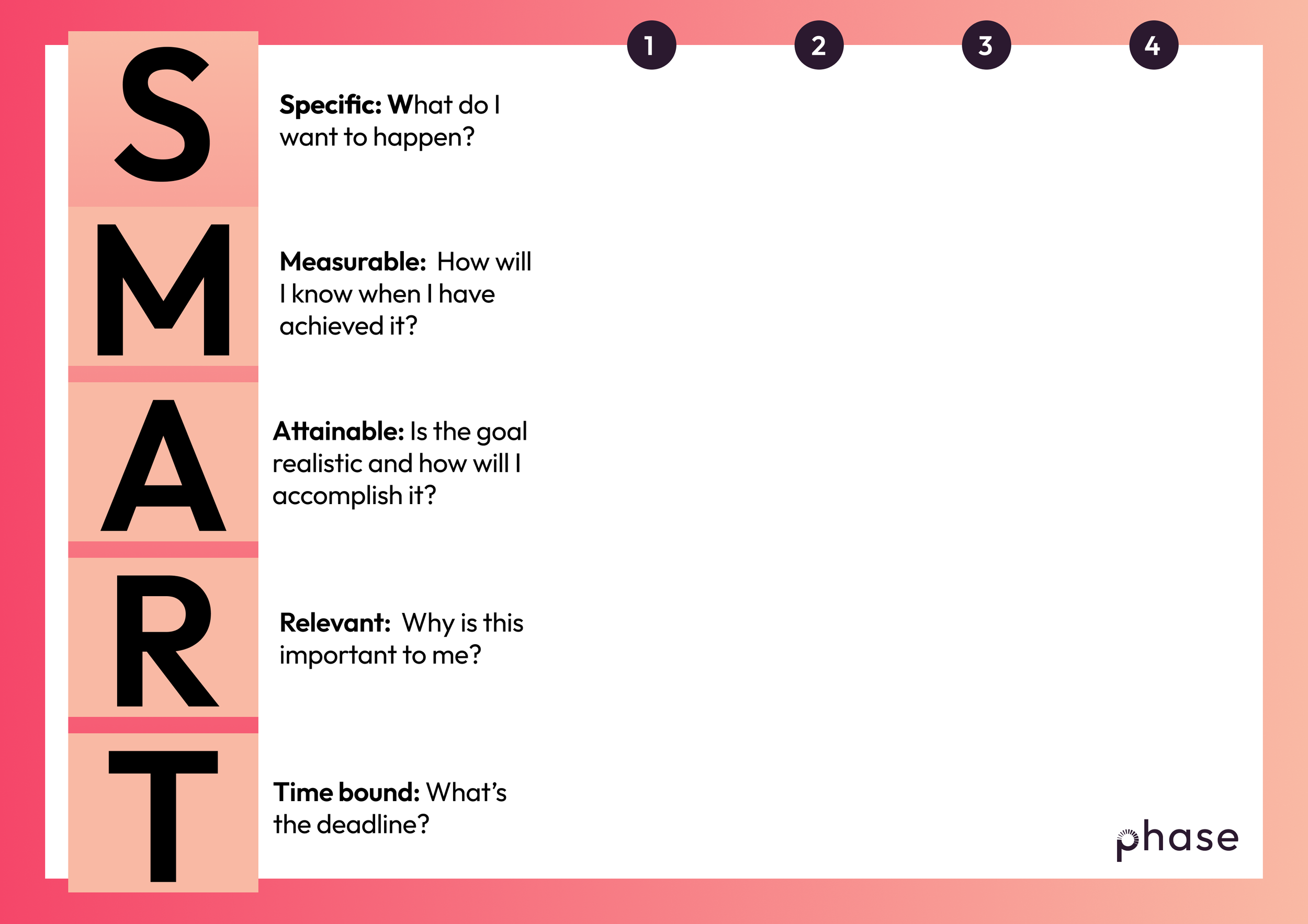
For each focus area, write ONE primary goal using this structure:
- Specific: What exactly will change?
- Measurable: How will you know you've achieved it?
- Achievable: Is this actually doable given your current life?
- Relevant: Does this matter to YOU (not Instagram, not your mother)?
- Time-bound: What's the deadline?
Example of vague goal:
"Get healthier"
Example of SMART goal:
"Reduce cycle-related fatigue by consistently sleeping 7+ hours on 6/7 nights and tracking energy patterns in Phase by March 31, 2026"
See the difference? One is a wish. One is a plan.
Break It Into Quarterly Milestones
Annual goals feel distant. Quarterly milestones feel urgent.
For each goal, define:
- Q1 (Jan-Mar): What gets established?
- Q2 (Apr-Jun): What gets built on?
- Q3 (Jul-Sep): What gets solidified?
- Q4 (Oct-Dec): What gets completed/evaluated?
Example:
Annual goal: "Build $5K emergency fund"
- Q1: Save $1,250 (set up auto-transfer, cut 2 subscriptions)
- Q2: Save another $1,250 (sell unused items, negotiate bills)
- Q3: Save another $1,250 (side project income)
- Q4: Save final $1,250 + evaluate next financial goal
Now you're not looking at an overwhelming annual target. You're looking at 90-day sprints.
Part 4: How to Actually Achieve Your Goals (The Evidence-Based Part)
This is where most goal-setting advice stops. Here's where Phase starts.
1. Write Them Down (Physically)
A study by Dr. Gail Matthews at Dominican University found that people who wrote down their goals were 42% more likely to achieve them than those who only thought about them.
Why it works: Writing activates the Reticular Activating System (RAS) in your brain—the filter that decides what information gets your attention. Once written, your brain starts spotting opportunities and resources related to that goal.
Action step: Write your 4-5 goals on paper. Keep them somewhere you'll see them weekly (inside your planner, on your bathroom mirror, in your Phase notes).
2. Schedule Weekly Goal Reviews
Intentions without monitoring are just wishes.
Block 15 minutes every week (same day/time) to review:
- What progress did I make this week?
- What got in the way?
- What's my focus for next week?
Cycle-sync this: Review during your follicular or ovulation phases when you're naturally more action-oriented. Use luteal for deeper monthly reflection.
3. Monitor Progress with Measurable Metrics
You need data, not feelings.
For each goal, decide:
- What am I tracking? (hours, dollars, occurrences, ratings)
- How often? (daily, weekly, monthly)
- Where? (Phase app, spreadsheet, habit tracker)
Example:
Goal: "Improve work-life boundaries"
Metric: Track "# of nights working past 7pm" and "# of weekend work hours"
Frequency: Weekly tally every Sunday
Location: Phase weekly review note
Why it works: Neuroscience research shows that tracking activates your brain's reward system. Small wins become visible, which releases dopamine, which motivates continued effort.
4. Visualize Obstacles (Not Just Success)
Positive visualization is popular. But research by Gabriele Oettingen shows that "mental contrasting” visualizing both success AND obstacles, is significantly more effective.
She has outlined the WOOP Method, which considers:
- Wish: What's your goal?
- Outcome: What's the best result?
- Obstacle: What will try to stop you?
- Plan: How will you handle that obstacle?
Example:
- Wish: Complete online certification
- Outcome: New skills, career advancement, confidence boost
- Obstacle: Low energy during luteal phase makes study hard
- Plan: Schedule study sessions during follicular/ovulation phases, use luteal for passive learning (videos, reading)
Action step: For each major goal, write down 3 likely obstacles and your specific plan for each.
5. Tie Goals to Identity (Not Just Outcomes)
James Clear (Atomic Habits) emphasizes identity-based goals: Focus on who you're becoming, not just what you're achieving.
Outcome-based: "I want to run a 5K"
Identity-based: "I'm becoming someone who moves their body regularly"
Why it works: Identity shifts change behavior at the root level. When you see yourself AS someone who does X, decisions become automatic. You're not forcing yourself to act against your identity—you're acting in alignment with it.
Action step: For each goal, complete this sentence:
"I'm becoming someone who __________."
Examples:
- "I'm becoming someone who honors their energy cycles"
- "I'm becoming someone who protects their financial future"
- "I'm becoming someone who sets boundaries without guilt"
Part 5: The Phase Advantage (Using Your Cycle as Your Strategy)
Here's what traditional goal-setting misses: Your capacity isn't consistent. Your focus, energy, risk tolerance, and creativity shift across your cycle.
Map Your Goals to Your Cycle Phases
Follicular Phase (Days 1-14ish): Rising estrogen, increasing energy
- Best for: Starting new habits, tackling hard tasks, making progress on challenging goals
- Goal work: Intensive focus sessions, difficult conversations, ambitious pushes
Ovulation Phase (Days 12-16ish): Peak estrogen and testosterone
- Best for: Collaboration, presentations, networking, high-stakes decisions
- Goal work: Pitching ideas, scheduling important meetings, social-heavy goal work
Luteal Phase (Days 15-28ish): Progesterone rises, estrogen drops
- Best for: Detail work, editing, quality control, realistic assessment
- Goal work: Reviewing progress, refining systems, course-correcting plans
Menstrual Phase (Days 1-5ish): Hormone levels low
- Best for: Rest, reflection, strategic thinking, pattern recognition
- Goal work: Monthly goal reviews, celebrating progress, planning next month
How to use this: When planning your quarterly milestones, note which cycle phases you'll be in during crucial deadlines or intensive work periods. Schedule accordingly.
Use Phase to Track Goals + Energy Patterns
Phase isn't just a cycle tracker - it's your goal monitoring system.
Set up in Phase:
- Log your goals in notes or tasks
- Track weekly progress alongside cycle data
- Notice patterns: Do certain goals get easier in certain phases?
- Adjust your approach based on what your data shows
Example: If you notice you always skip workouts during luteal phase, stop fighting it. Schedule movement goals for follicular/ovulation, and shift to gentle stretching or rest during luteal. You're not failing—you're adapting.
Part 6: Your 2026 Goal-Setting Checklist
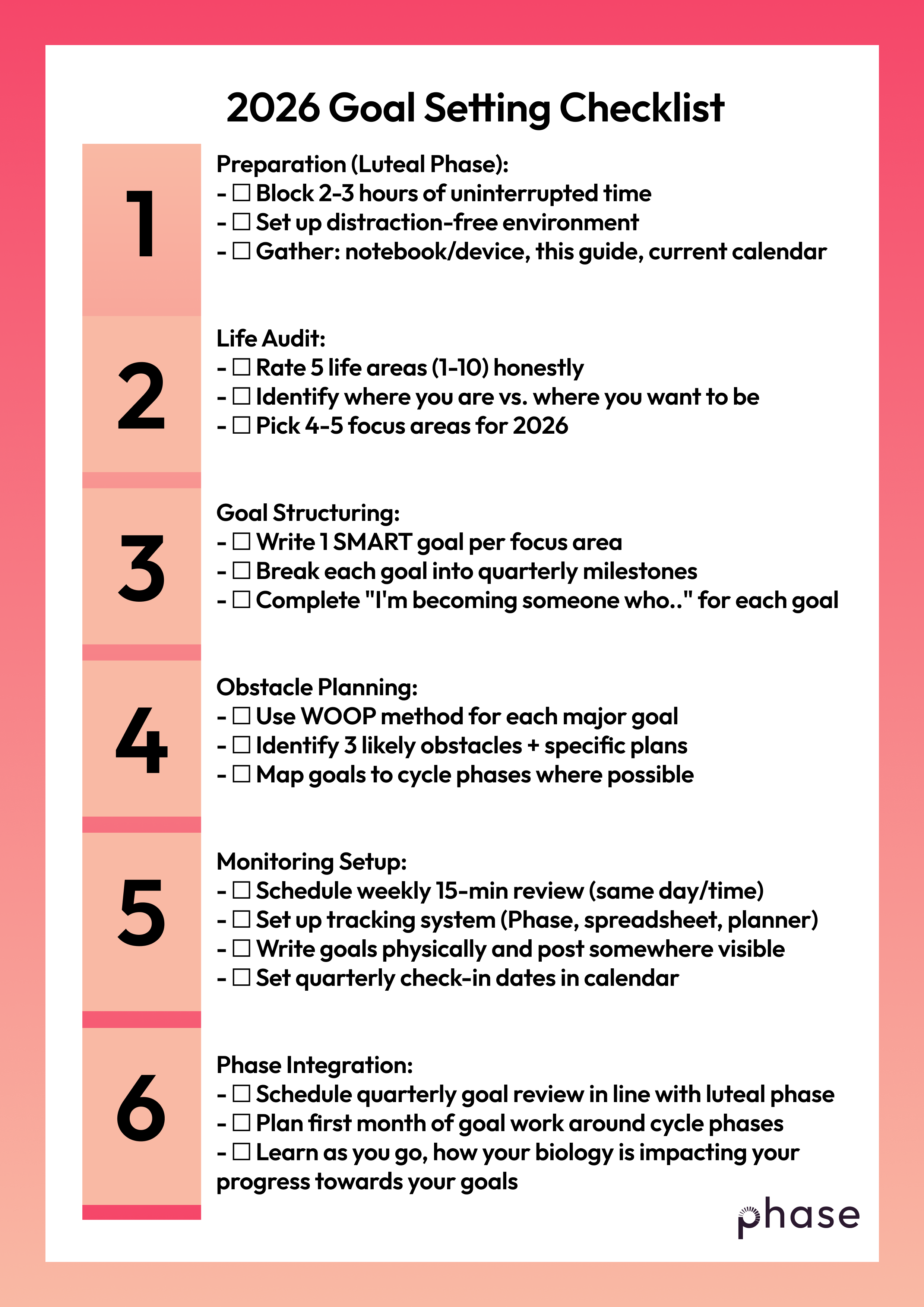
Here's your full goal-setting process, in 6 easy steps. You can also download the checklist from the file linked at the top of this document.
Preparation (Luteal Phase):
- ☐ Block 2-3 hours of uninterrupted time
- ☐ Set up distraction-free environment
- ☐ Gather: notebook/device, this guide, current calendar
Life Audit:
- ☐ Rate 5 life areas (1-10) honestly
- ☐ Identify where you are vs. where you want to be
- ☐ Pick 4-5 focus areas for 2026
Goal Structuring:
- ☐ Write 1 SMART goal per focus area
- ☐ Break each goal into quarterly milestones
- ☐ Define measurable metrics for tracking
- ☐ Complete "I'm becoming someone who..." for each goal
Obstacle Planning:
- ☐ Use WOOP method for each major goal
- ☐ Identify 3 likely obstacles + specific plans
- ☐ Map goals to cycle phases where possible
Monitoring Setup:
- ☐ Schedule weekly 15-min review (same day/time)
- ☐ Set up tracking system (Phase, spreadsheet, planner)
- ☐ Write goals physically and post somewhere visible
- ☐ Set quarterly check-in dates in calendar (end of Mar/Jun/Sep/Dec)
Phase Integration:
- ☐ Schedule quarterly goal review in line with luteal phase
- ☐ Plan first month of goal work around cycle phases
- ☐ Learn as you go, how your biology is impacting your progress towards your goals
Conclusion
You now have what most people never get: a goal-setting system that accounts for your actual biology, uses evidence-based achievement strategies, and includes a realistic monitoring plan.
This isn't about willpower. It's about working with your brain and body instead of against them.
Your luteal phase will keep you grounded. Your quarterly milestones will keep you moving. Your weekly reviews will keep you honest. And your cycle-aware planning will give you an edge most people don't even know exists.
Set your goals during your next luteal phase. Monitor them weekly. Adjust them as you learn what works for your specific patterns.
For the first time, you're not just setting goals. You're setting yourself up to actually achieve them.
Ready to track your goals alongside your cycle? Download Phase and turn your biology into your biggest strategic advantage.
Photo by S O C I A L . C U T on Unsplash